Monday, August 05, 2013

Dzhokhar Tsarnaev case: Witnesses for the Prosecution?


The "epicenter question" - where exactly did the second bomb explode - is of crucial importance for the Dzhokhar Tsarnaev lawsuit and, thanks to the exact topographic description in the initial complaint, equivalent to the question whether he's guilty or not. If the epicenter was at the metal barriers near the mailbox, he's very probably guilty. If the epicenter was on the Forum's patio, he's most likely not guilty.

Beginning with this blog entry from April 23th, I've made no pretence of my conviction that the patio was the epicenter of the second bomb, based on numerous eyewitness statements and photographic evidence. I also pointed out that the "official epicenter story" began to change early, even before the hunt on the Tsarnaev brothers was heralded: the epicenter somehow "moved" from the patio to the mailbox, and most of the media played along by publishing dubious photos and graphics with the strong insinuation that the epicenter was beside the mailbox. The facebook tweet of Barbara Ray-Velazquez, sent on April 17th, concisely reflects this medial metamorphosis.

In my April blog entries I featured several witnesses whose accounts directly or indirectly imply that the second bomb exploded right on the patio. In this early stage, I didn't find any witness who distinctly confirmed the official "mailbox" story. A new search a few days ago has revealed however that there are indeed witnesses for the mailbox version, among them: Jarrod Clowery and Steve Byrne.


Jarrod Clowery (source: CNN)


                               Steve Byrne (source: ABC News)


Jarrod Clowery was heavily injured, but he escaped the fate of so many other victims who lost their limbs. He was not reluctant to speak with the media. I've listed some of his statements in the appendix. He's very clear about where he was in relation to the second bomb:
Something told Clowery the group would be safer in the middle of Boylston Street than behind the waist-high spectator barricade outside the bar. He put one hand on the barricade and began to vault it. When the second bomb went off at ground level just a few feet away, Clowery’s legs were atop the metal fence. That’s why he still has them.
So Clowery was just leaping a barrier when the second bomb exploded. He estimates he was only three feet away from it:
“I was hopping the railing when I heard the first bomb go off,” Clowery recalled. “I told everybody, ‘Get in the street, get in the street!’ I was three feet from the bomb. The bomb blew under me, filling me from my ass to my ankles in shrapnel but, obviously, leaving me whole.”
He was blown into the street:
He was blown into Boylston Street by the blast and opened his eyes to a scene of unspeakable carnage. A few feet away, a small boy lay dead. The street was awash in blood, littered with body parts.
There's a photo with him sitting on the street with torn clothes:

                                 source: Kenshin Okubo/AP

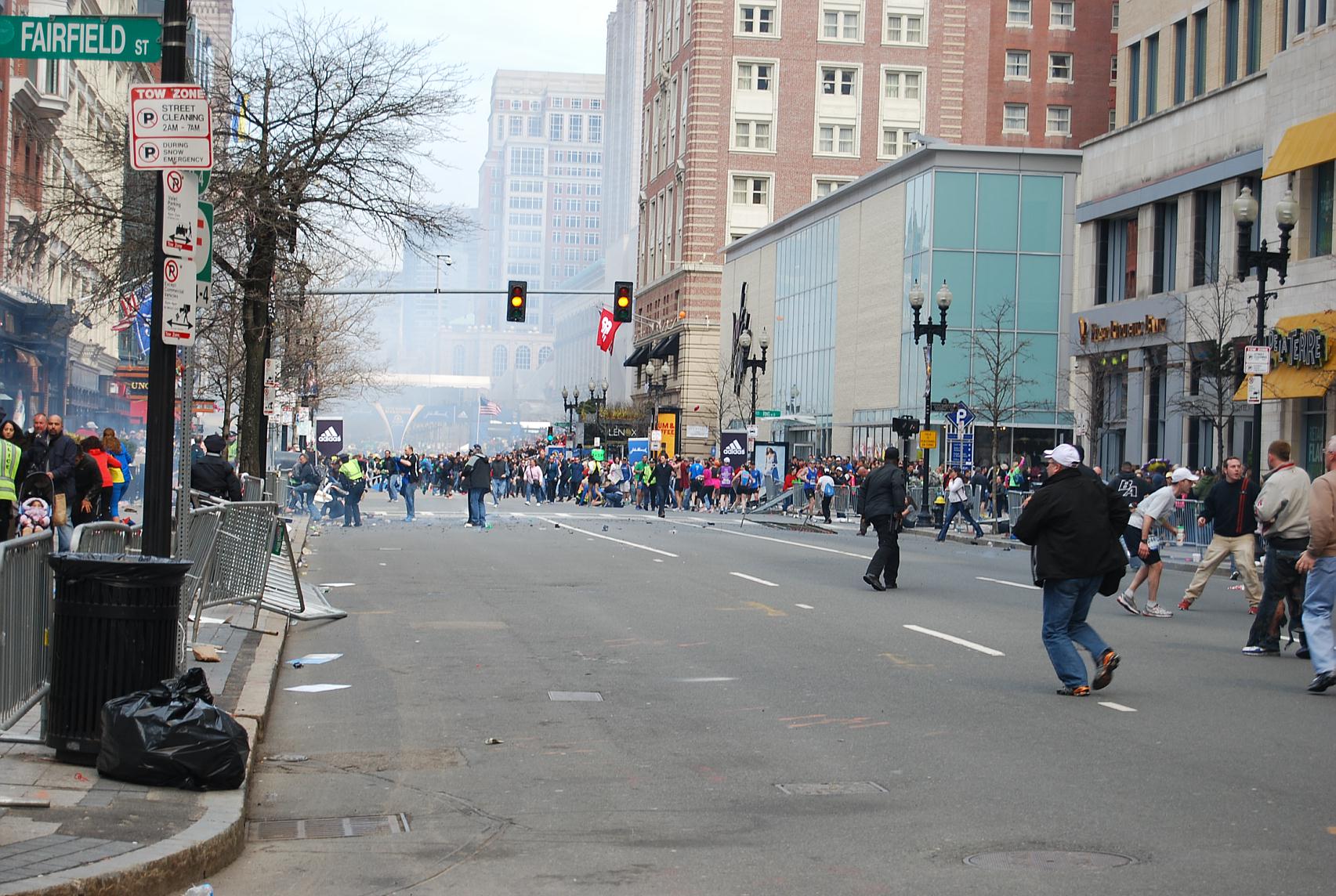
In the background, there is a crosswalk and a pole. They indicate that Clowery is sitting right on the crossing Boylston Street/Ring Road. This is confirmed by a second photo:
                              source: cryptome.org

In the center of this image, on the right lane of Boylston Street below the red light, there is an obviously injured person who gets help from bystanders. Here's a zoom in:


The location of this group of people (Boylston Street/Ring Road) matches the first photo. The lady with blue jeans and the black cap who cares for Clowery in the first photo is identifiable on the second, too (with her right knee on the ground). The two photos confirm each other, and there can be no doubt about Clowery's location after the blast.

To complete the picture, only one question remains: which barrier did Clowery try to leap over? There are two candidates: the barrier which was blown across the street (you can see it in the second photo), and the deformed barrier which was wrapped around the mailbox. The fact that the first candidate was blown into a different direction than Clowery himself makes the deformed barrier the only remaining possibility.

Clowery's statements and the photos result in the following diagram:


Adding the injured people in the immediate aftermath of the explosion to the picture, the crime scene looks like this (please look here for background information and an explanation of the diagram):


It is remarkable that, while Clowery was blown away at least 30 feet, victims B, C, and D were forced to ground without being displaced. They seem to be more seriously injured than him though. In case the prosecution intends to summon Jarrod Clowery as a witness it should be aware of these oddities.


Steven Byrne is also very detailed in his accounts (see appendix): he was watching the runners, and the mailbox was, from his point of view, right of him, and saved him:
The mailbox Byrnes was standing next to shielded him from the worst of the blast.
However, as the available photos show, the mailbox was outside the barriers, i.e. if the mailbox protected Byrne, the bomb must also have been outside the barrier (at location 1 in the next diagram):


The official story - "Tsarnaev's bag was the second bomb" - is reflected by location 2. But there is no mailbox between location 2 and Byrne: he's fully exposed to the bomb.

Moreover, he claims that the blast blew him over the barrier, just like Clovery:
BYRNE: And just as he said that, is when the explosion hit. It blew me over the fence into the streets and stuff some of --
COOPER: It actually carried you over?

BYRNE: It carried me over.
Obviously a bomb at location 1 or 2 wouldn't have taken Byrne over the barrier - wrong direction. If we assume this really happened, the bomb must have been placed in his back, somewhere near location 3. But this has not been claimed by anyone, and there's no evidence at all for location 3 being the epicenter.

Byrne's statements are puzzling, and the prosecution should take that into regard if it intends to summon him as a witness against Tsarnaev.


Disclaimer: I don't accuse any of the persons mentioned in this article of intentionally and voluntarily saying the untruth.


Appendix - the statements of Jarrod Clowery and Steve Byrne


“Before I could finish saying, ‘Get your ass in the street,’ boom!” Clowery recalls.

He was blown into Boylston Street by the blast and opened his eyes to a scene of unspeakable carnage. A few feet away, a small boy lay dead. The street was awash in blood, littered with body parts. Costello was tangled in a barricade, his shirt and pants partially burned away.

“I actually thought to myself, ‘Are these my last breaths?’ ” Costello recalls. “From head to toe, I was like on fire.” He got up and started to make his way down Boylston Street, his shirt smoldering, asking for help. No one came to his aid in those first few moments. He sat on the curb and pulled two nails from his abdomen.

Chain-smoking on a bench beside the Mystic River outside Spaulding, Clowery could be any guy in long, dark sweatpants and a light sweatshirt, until he rolls up his sleeve to show what looks like a small field of blackheads on the underside of his left wrist. It is actually debris — wood, plastic, dirt and other detritus blasted into his arm by the bomb. The nastiest wound is from a hot nail that entered his skin lengthwise. Sometimes Clowery uses tweezers to pull out tiny bits. Surgeons have removed denim from his thigh.

In his right leg are three nails, 20 BBs and a metal spring. He faces more surgery to remove some of the objects, but others will be left to work their way to the surface or remain in his body forever. His left hand, contracted and burned by the blast, has been massaged back to health by occupational therapists. Sometimes it shakes uncontrollably.

The two bombs killed three people and injured more than 260. Clowery was sure his friends were among the dead. He remembers arguing with medical personnel before finally accepting that some had been brought to the hospital with him. “You didn’t see what I saw,” he told them.
Everyone in the Stoneham group survived. But both Norden brothers lost their right legs. Fucarile lost his right leg and suffered severe damage to his left. Costello was badly burned. Webb suffered shrapnel wounds in both legs, but, like Clowery, has gone home.

http://theweek.com/article/index/244276/finding-a-new-normal-after-the-boston-bombings


J.P. Norden met up with some friends, including Fucarile and Clowery, and brother Paul met up with his girlfriend Webb and Costello. They came by different routes — using a combination of trains, subways, taxis, and cars.
They decided to meet in front of the Forum restaurant on Boylston Street, where they knew Jefferson’s mother and family were tracking his race online on their phones.
Several of them were taken aback by the $25 charge to enter the Forum, so the friends decided to watch from the sidewalk.
When the first explosion hit a block away, J.P. Norden and Clowery were next to each other. Clowery remembers yelling, “Get into the street!” and jumping a guardrail.
He had his hands and feet on the guardrail and was yelling to Webb to jump as well, when the second blast unleashed. J.P. stayed on the ground, helping his brother to hoist Webb over the rail.
Being above-ground likely spared Clowery’s legs, while being on the ground claimed the Nordens’ and Fucarile’s.


“I was hopping the railing when I heard the first bomb go off,” Clowery recalled. “I told everybody, ‘Get in the street, get in the street!’ I was three feet from the bomb. The bomb blew under me, filling me from my ass to my ankles in shrapnel but, obviously, leaving me whole. The others were still flat-footed on the ground. That’s why they took the brunt of the damage. But let me tell you something: My friends Marc, J.P., and Paul are pretty big guys. They saved people’s lives by taking that blast. And now they need help.”


They heard the first explosion and Clowery said, “I had this gut feeling it was bad, and could feel the crowd shifting and thought we should try to get out into the street,” from behind the barricades penning in spectators. They were close to the mailbox that can be seen in many photographs, standing just behind the row of people leaning on the railing lining the street.

He shouted at his friends to “move, get your ass out into the street” and hop the metal fencing. He got both of his hands onto the railing, but before they all could clamber over, another bomb went off. Clowery believes he already was in the air, clearing the metal guardrail, when the explosion hit, which may have saved his legs. His friends still were grounded. “They’re all big guys. I think they spared some other people when they took that impact.”

“I just prayed for no more explosions,” and “then I’m not clear about everything. I was stunned” and out on the street, pants torn and receiving aid from two police officers, one a Connecticut state trooper and another an officer from a Connecticut town, television footage shows. He’s made a point of learning their names so he can say thank you-he has so many thank yous, he said. “My leg was like hamburger and my hands were messed up.”

http://www.washingtonpost.com/blogs/liveblog/wp/2013/04/23/boston-marathon-bombings-stories-of-the-victims/


When he heard the first explosion, Clowery said, he knew it was not an accident. "I knew right away in my gut it wasn't a gas leak," he said. "I saw the open space in the street, I said, 'Let's get in the street.'"

As Clowery cleared the railing, he paused to urge his friends to follow him. That was when the second bomb exploded.

"I remember feeling engulfed," he said. "Just like the movies—all the sound got taken away."

Clowery continued: "I remember trying to count my fingers and feel my feet. My hand was too much to look at."
He looked down at his legs. He didn't want to look at them, either.

http://news.yahoo.com/blogs/lookout/jarrod-clowery-boston-bombing-victim-tom-brady-194330265.html


At a press conference at Boston's Brigham and Women's Hospital, Clowery said, "When the first explosion goes off, my friend says, 'What the...!'" Clowery, a carpenter from Stoneham, Mass., went to watch the finish with four of his childhood friends outside Forum bar. He says when the first bomb went off, he knew right away what it was. Instinct told him to jump the crowd-control fencing and get onto Boylston Street.

He hoisted himself up, pausing only long enough to scream to one of his friends to get to the street too. Little did he know, that he may have been just above the second bomb. "And then, boom!" Clowery said. "I remember feeling engulfed," he said. "I got thrown into the street and then, just like the movies, all the sound got taken away."

http://www.comcastsportsnet.com/landing?Marathon-bombing-survivor-Jarrod-Clowery=1&blockID=839549&tagID=733


COOPER: So where were you standing? Just so in relationship to the first explosion?

BYRNE: We were at the second --

COOPER: You were at the second?

BYRNE: Yes.

COOPER: Wow.

BYRNE: And there was right where you see the picture where they show the backpack and the mailbox, that's exactly where we were.

COOPER: So you are -- if you were facing the mailbox you were to the right of it?

BYRNE: Just to the left of it. They were to the right of it.

COOPER: OK.

BYRNE: So that's why they suffered, you know.

COOPER: So the shrapnel that hit you is shrapnel that came over the mailbox?

BYRNE: Came all those BB's, nails. So, you know, my friend had 70 nails in his leg.

COOPER: Seventy nails.

BYRNE: Seventy nails. And you know, I had BBs, there's still one in my neck that the doctors couldn't take out because it's too close to my nerves that control my vision. Most of my face came out, you know, due to the surgery and stuff like that. And just burns. I mean, it burned the clothes right off of us, it was --

COOPER: Really? Your clothes were actually burned off you?

BYRNE: Right off of us. Just undescribable.

COOPER: Do you remember the blast?

BYRNE: I remember everything about it.

COOPER: Really?

BYRNE: Yes.

COOPER: Can you walk me through? I mean, what stands --

BYRNE: The first explosion went off just down the block from us. And --

COOPER: Did you know something was wrong then?

BYRNE: We knew it wasn't something to do with the marathon, and, you know, we were ready to get going and get out of there, and our friend, you know, Jared said, let's get the girls over the fence. And just as he said that, is when the explosion hit. It blew me over the fence into the streets and stuff some of --

COOPER: It actually carried you over?

BYRNE: It carried me over, and just the force, and the heat, and the burn from it, the chemicals in the bomb, just had me on fire and everyone else -- as I came through, just in the days of, you know, what was going on, just looking for my friends and stuff like that. It was just absolute chaos. You know, I saw things that, you know, I wish I didn't see. You know, people losing limbs and just stuff -- it was bad.

http://transcripts.cnn.com/TRANSCRIPTS/1304/17/acd.02.html


Steve Byrnes and his buddies, JP and Paul Norden, were enjoying the spectacle. They didn't notice the man nearby setting down his backpack.

"It's an eerie picture because that was taken on the good part of the day when we were having a blast," said Byrnes, looking at a screenshot from surveillance video that shows the Boston bombing suspect in the background.

"I'm deaf in my right ear. A little bit of vision loss in the right eye. Shrapnel in my face still that, for whatever reason, needs to stay there," Byrnes said. "The one in my neck needs to stay because it's on my jugular vein and the nerves that control my vision."

His friends, JP and Paul Norden, each lost a leg. The mailbox Byrnes was standing next to shielded him from the worst of the blast.

http://www.cbsnews.com/8301-18563_162-57580846/boston-bombing-victim-i-had-a-guardian-angel/


Tuesday, July 16, 2013

Boston Marathon: Analysis of the Second Bomb Crime Scene

Dzhokhar Tsarnaev's bag was not the second bomb


This diagram depicts the Forum crime scene in the first seconds after the explosion's dust had settled. The ovals represent the locations of heavily injured persons sitting or lying on the ground.

According to several eyewitness accounts, some people were blown inside the restaurant by the blast. They are represented by the yellow ovals. The number (four) is an estimation and may be too high or too low. 

The green ovals represent injured persons on the sidewalk who are not visible or identifiable on the available photos, because they are covered by people standing around them. Again, the number may be a bit too high or too low, but this doesn't matter in order to achieve a good overview.

The red ovals represent injured persons who are individually identifiable on at least two of the following photos.

A - black shirt, male/female   photos 1, 2, 3, 4
B - white shirt, male   photos 1, 2, 5
C - green(?) shirt, light-colored trouses, male  photos 1, 2, 4
D - lying on the ground, heavily injured, male    photos 1, 4
E - long curly blond hair, female   photos 1, 3, 4

Photos 1 and 2 are the same shot; in photo 2, certain parts are blurred out, allegedly due to graphic. I posted it nevertheless, because the unredacted parts have a better quality than photo 1.

Photos 3 and 4 are different shots, taken only 1 or 2 seconds after another from different points.

Photo 5 is taken out of a video clip. Victim B is seen sitting on the sidewalk on the right side.

1


2


3


4


5


Most if not all of the injured people were displaced by the explosion. The epicenter of the bomb itself must have been emptied due to the enormous force of the blast. There is only one place which is 1) empty within a certain radius and 2) situated in the center of all injured persons. This is the entry area of the Forum's patio: 


Now the prosecution claims that Tsarnaev put his bag at the metal barriers (one metal barrier was blown across the street, as you can see on picture 1). The next diagram illustrates the hypothesis that his bag was the Forum bomb:


The diagram looks utterly unrealistic; this "bomb" didn't blow away the people next to it, yet it was somehow able to blow people from the patio inside the restaurant. Even a layman can see that this is not in accordance with elementary physics. It is also not in accordance with the available eyewitness reports (some of them I've featured in former blog entries).

The witnesses and pictures speak a plain language: Dzhokhar Tsarnaev's bag was not the second bomb.


Monday, June 03, 2013

Stephen Jones, TimMcVeigh lawyer, on the Dzhokhar Tsarnaev case


Stephen Jones was the defense lawyer of Timothy McVeigh, the Oklahoma bomber. When the criminal complaint against Dzhokhar Tsarnaev was published on April 22, he was interviewed about the judicial implications and consequences.

Jones explains that within 30 days after the complaint the government has to come up either with an indictment or a preliminary hearing, which is an opportunity for the defense to avoid a trial in front of the Grand Jury if the prosecutors fail to convince the judge of the "probable cause". In this case the complaint is dismissed. If the judge decides to forward the case to the Grand Jury, the prosecutors still have plenty of time to gather material for the indictment.

In the case of Dzhokhar Tsarnaev, the 30 day deadline was prolonged by a week from start because of his precarious physical condition. But the prosecution pleaded a postponement of the May 30 deadline because they needed more time to gather evidence. First, it was re-scheduled for July 2, then another delay was announced and the hearing will now (probably) take place on July 10.

In the light of Jones' elucidations, the prosecutors seem to be unsure if they have enough evidence to guarantee that the case survives the preliminary hearing, because there's no need to present the full list of charges against Tsarnaev. They have plenty of time to gather material for the indictment after the preliminary hearing.

So the case against Tsarnaev looks to be pretty wobbly, which is in grotesque contrast to the announcements of the FBI and the media's witchhunt for the brothers. In the words of Stephen Jones: "It'll will be interesting to watch."

Here is the full interview:

Tim McVeigh was the first person charged with the crime of the use of a weapon of mass destruction. I've read the complaint filed ((vs. Dzhokhar Tsarnaev)) and I suspect - that's just my opinion from a great distance - that the government has plead a case within the confines of the statute, and the statute requires among other things an adverse impact on interstate commerce and public safety. And certainly the Boston Marathon has an impact on interstate commerce - if nothing else, the tens millions of dollars spent in hotels and restaurants and so force.

So I suspect that a facial challenge, that is just on the face of the indi...of the complaint will survive scrutiny, now whether they can expand that for an indictment remains to be seen. He's charged with the criminal complaint today. That means the government must have a preliminary hearing within 30 days or take the case to the Grand Jury. In Mr. McVeigh's case, the government had the preliminary hearing and then went to the Grand Jury and the indictment wasn't returned for four months.

Preliminary hearings are not that difficult for the government and my guess is he will have the preliminary hearing which will usually consist of one FBI agent and one not really knowledgeable with the case, so his testimony isn't really that helpful to the defense. I would be surprised if the government pushes for an early indictment. I think the indictment would come when they know if there are others abroad, when they have more details about the offense. I'd be very surprised if an indictment is returned within 30 days.

He's fortunate to have a federal pubic defender. Federal public defenders are certainly way above average in competence, experience and professionalism. They have significant ressources available that a private attourney would not. And I expect that the federal public defenders would take their job seriously. They assisted me significantly when I was Mr. McVeigh's lawyer - the public defender in Oklahoma disqualified because her office was damaged by the bombing. That's not the case in Boston. So he has a good defense team and it'll be interesting to watch.

I think the defense attourney in the Boston case will be under a lot of media scrutiny, public scrutiny, and certainly will be a personal challenging experience - it's an professional challenge, but I can well imagine having lived through it myself what he or she or a group of them will face in defending a client that is quickly being made by the media into the most hated man in America.

Here's the video of the interview:

http://timesofindia.indiatimes.com/videos/news/Dzhokhar-Tsarnaev-has-good-defense-team-Timothy-McVeigh-lawyer/videoshow/19706422.cms 

Here are some biographic notes on Stephen Jones (source: Wikipedia). This man is certainly not someone who bows to pressure from politics or media:

On May 5, 1970, the day after National Guardsmen had shot and killed four students at Kent State University, Keith Green was arrested at the University of Oklahoma for carrying a Viet Cong flag in violation of a state law prohibiting the display of a "red flag or emblem of anarchy or rebellion". After 12 lawyers had refused to defend the student, Jones took the case and was promptly dismissed from the Enid, Oklahoma law firm where he was employed. Jones argued in court that the disloyalty statute was unconstitutional and the judge dismissed the case, overturning the statute. Later Jones would go on to represent Abbie Hoffman, the radical Yippie, when Oklahoma State University refused to let him speak on campus. 

In 1975, Jones defended Bobby Wayne Collins who was accused of the worst mass killing in Oklahoma history at the time. Mervin Thrasher (28), his wife Sandra (27), their two young children (Penny (5) and Robert (18mos)) were senselessly murdered in their four room farm home one mile north of Woodward Oklahoma. Collins was found guilty and sentenced to death for the brutal crime. On appeal in 1977, Jones successfully had Collin’s death sentence commuted to a life sentence. Bobby Wayne Collins is scheduled for a parole hearing in July 2009. 

Jones ran unsuccessfully for public office four times, including a U.S. Senate race against David Boren in 1990.

In 1997, Stephen Jones was the lead defense attorney for Timothy McVeigh, who was on trial for the Oklahoma City bombing. McVeigh wanted to use the "necessity defense," but Jones took a different tack, even traveling to other countries in search of evidence because he believed that McVeigh did not act alone in the bombing. McVeigh was convicted on all counts and executed in 2001. 


Tuesday, April 30, 2013

Mike Chase - Witness for the Defense

in the case We the People vs. Dzhokhar Tsarnaev 


 source: Salem News

Mike Chase (left) and Dan Marshall were at the Atlantic Fish Restaurant, which is just beneath the Forum, their patios being separated by a planter. The photo is taken one hour before the blast, at Atlantic Fish. 

Mike Chase was so close to the bomb that he was blown off (apparently, he was lucky not to be seriously injured). His account makes it possible to narrow down the epicenter of the second bomb pretty well. Between him and the bomb, there was only the said planter.

The following link and snapshot are taken from the side bar of the main article. Mike Chase pinpoints his position very exactly as being under the light at the border between the two restaurants, i.e. he was very close to the buildings.


http://www.salemnews.com/archive/x210919298


Here ist the complete article. I've highlighted the most important parts.  

http://www.salemnews.com/local/x210919302/Danvers-men-were-at-epicenter-of-second-blast 


DANVERS — By chance, Danvers High soccer coach Mike Chase and his friend, Danvers High custodian Dan Marshall, found themselves with family and friends at the epicenter of the second Boston Marathon bomb blast Monday afternoon.

It started as a glorious day with great company, Chase with his wife, Dena, and Marshall with girlfriend Lauren Gibbs of Gloucester, standing out at a high-top table with a prime viewing spot of the race in front of the Atlantic Fish Co. on Boylston Street.

But it did not end that way.

“It was a great day up until that point,” said Marshall, who ran into Chase by chance at the Beverly train station and told him where they were headed to watch the marathon. They didn’t see each other again until they met up at the restaurant.

Chase later helped an off-duty Lynn firefighter carry a severely injured young boy to an ambulance 30 yards from where the second bomb went off.

Marshall tended to 8-year-old Martin Richard, the Dorchester boy who was killed in the blast and who has become the face of the tragedy. Bill Richard, the boy’s father, is a 1988 graduate of Salem High. The boy’s mother and little sister were also injured in the bombings.

“It’s extremely sad,” said Marshall, 32, who graduated Danvers High in 1998, a year behind Chase, 34. “It’s extremely sad, but I don’t know what happened. I just sprang into action. He was the first one I saw, and I sprung to him. I wish I could’ve helped more.”

Marshall said he and Chase are not heroes. “We did what we had to do.”

Chase described the first blast as taking place about 75 yards to their left. He was on the phone with his brother trying to direct him to the restaurant. Seconds later came the second blast, a white flash, then a bang, which Chase described as a loud, high-pitched scream followed by silence. He was blown back. He said he was lucky to be standing next to a 21/2-foot-tall planter.

“That’s the only reason my legs didn’t get blown off,” Chase said.

He jumped on top of his wife and Marshall’s girlfriend to cover them while waiting for the smoke to clear. He then moved them to an alcove at the front of the restaurant. He remembers screaming into his cellphone for his brother, in town for a Bruins game, to “get out of the city!”

Inside the restaurant, he found that his sister-in-law, Taylor DeLuca of Danvers, and her boyfriend, Andrew Bartlett of Gloucester, were safe. Marshall’s sister, Jackie Marshall of Danvers, and her boyfriend, Steve Foss of Salem, along with another relative, Kellie Marshall of Danvers, were also at the restaurant and escaped unscathed.

Back outside, Chase could not find Marshall but saw off-duty Lynn firefighter Matt Patterson helping a 6-year-old boy who had his leg blown off below the knee. Patterson motioned for Chase to give him a hand. Chase took off his belt and used it as a tourniquet on the boy’s leg.

The two decided to carry the child to an ambulance about 30 yards away, with Chase applying pressure to the boy’s leg. He said the boy was awake and alert, and he held the boy’s hand. A man who Chase assumes was the boy’s father was there holding his 11-year-old son. Chase asked the father to cover the boy’s eyes. Once they got to the ambulance, Chase had the father sit the boy down on the curb, and he sat with him and tried to answer all his questions while the father went to the ambulance.

When the father came back, Chase headed back to where the second blast had occurred. That’s where he found Marshall, who had removed his shirt and was working with others on an injured boy, who Chase later found out was Martin Richard.

Chase moved some metal barricades so the injured could be brought to the ambulances and passed some backboards forward.

When it became clear there were enough “professionals” there, they moved away. They spoke with a Boston police and went to find their family and friends. Mike’s brother, Brad Chase of Danvers, and his wife, Jen Chase, a nurse, were waiting at Massachusetts General Hospital, and they jumped in a car and headed to Salem Hospital, where Chase learned he had a ruptured eardrum and a concussion. Otherwise, they were all OK.

“Just a really tough day,” Chase said, “but we will do what we do to get through it.” Chase said he hopes the little boy he attended to pulls through.

Many people have been reaching out to Chase, including his own father.

“He was shocked like everyone else, but he was very proud of me,” Chase said.

Chase, 34, almost became a police officer and had once attended the reserve police academy. His father is retired Danvers police Chief Stuart Chase, now the chief in Wolfeboro, N.H.

Chase spent six years on the reserve list in Danvers but suffered a blood clot in his lungs after knee surgery in 2004. Because he had to take a blood thinner, he was not eligible to become a police officer. In November 2006, when a Danvers ink and paint plant exploded, Chase, who lives not far from Danvers High, saw the fireball and tried to head to the scene to help.

On Monday, Marshall, who works for the town’s Department of Public Works as a custodian, had been at the barricade along the course looking for a college friend who was running the race. Marshall, who said he has run three marathons in San Diego, had wanted to run in Boston this year, but an injury sidelined him. He thought the first blast was fireworks or muskets of Revolutionary War re-enactors, and the second blacked him out momentarily. Then he sprung into the thick of things, taking off his belt to use as a tourniquet and giving his two shirts to others.

“It was so split of the moment,” said Marshall, who also suffered punctured eardrums and a concussion. “Some of the stuff I saw, you just phase it out while you are helping.”

If he can find a charity to join, he plans to run Boston next year.

“I’m hoping to,” Marshall said.

Sunday, April 28, 2013

Heather Abbott - Witness for the Defense


in the case We the people vs. Dzhokhar Tsarnaev


source: Ottawa Citizen


Heather Abbott lost a leg in the Forum explosion. She was waiting outside the restaurant to come in and was blown inside by the blast, through the doorway. It is impossible that the mailbox was the epicenter of this blast.

Here are two of her accounts (there are probably more):


She was injured by the second bomb, which went off in front of the Forum restaurant on Boylston Street. She was waiting in line with friends to get into the bar after taking in a Red Sox game, which is a Patriot's Day tradition for the Newport, R.I., resident. She and friends had come up by train from Providence.

After hearing the first, nearby explosion, Ms. Abbott immediately thought it was a terrorist attack—something she said leaves her leery of returning to the marathon or other crowded venues again. The next bomb went off quickly. Ms. Abbott, last in line among her friends, was on the floor as people scrambled to the back of the bar.

"I felt like my foot was on fire," she said. "I knew I couldn't stand up."

She wondered who could answer her cries for help in the chaos, but she was rescued quickly by several people. One, Matt Chatham, a former linebacker with the New England Patriots, helped carry her outside. They have talked since, and Ms. Abbott plans to meet him in the future.

http://online.wsj.com/article/SB10001424127887323335404578446502200309878.html

Abbott was at the back of the long line, waiting as bouncers checked ID's, when the first blast went off. Unlike many, she knew exactly what it was.

"I felt like I was watching the footage on 9/11," said Abbott, who works in human resources for Raytheon Company in Portsmouth, R.I.

Abbott was scrambling to get off the sidewalk when the force of a second blast blew her through the restaurant doorway.

After she'd regained her senses, she tried to stand, but her left foot felt "as if it were on fire." Unable to find her friends in the smoke and confusion, she called out to the panicked crowd.

"Somebody, please help me," Abbott shouted as people scrambled for the rear exits, not knowing whether there were more explosions to come. She'd begun to give up hope when a woman walked up and began dragging her toward the door, quietly reciting a Catholic prayer as she tugged.

"Hail Mary, full of grace...," the woman intoned.

The woman had pulled Abbott a few feet when a burly man stepped in, picked her up and carried her out the back door into an alley. She would later learn it was former Patriots linebacker Matt Chatham.

http://www.dailyherald.com/article/20130423/news/704239916


Thursday, April 25, 2013

Where was the epicenter of the second bomb?


Was it on the patio of the Forum restaurant in front of the entrance - or between the mailbox and the little tree at the roadside (which seems to be the actual state of the official narrative)? Judge for yourself.

These pictures are snapshots from the first seconds and minutes after the second explosion. They are authentic and unredacted. Maybe they don't belong to the material that is deemed to be credible to FBI Special Agent in Charge DesLauriers, but frankly, I don't care. I have added the URLs for copyright reasons.


http://i.imgur.com/Ot8xciz.png


http://timethemoment.files.wordpress.com/2013/04/lb_v2_img_9456_v2.jpg


http://tidalwave23.com/uploads/3/0/7/6/3076800/805216_orig.jpg


http://cryptome.org/2013-info/04/boston-bombs/pict91.jpg


http://cryptome.org/2013-info/04/boston-bombs/pict90.jpg


http://storage.canoe.ca/v1/dynamic_resize/sws_path/suns-prod-images/1297404504671_ORIGINAL.jpg


http://www.motherjones.com/files/BH6ju2NCMAAzhqs.jpg_large.jpg


http://wac.450f.edgecastcdn.net/80450F/ksoo.com/files/2013/04/Jackie1.jpg


http://cryptome.org/2013-info/04/boston-bombs/pict13.jpg


http://wac.450f.edgecastcdn.net/80450F/ksoo.com/files/2013/04/Jackie1.jpg


http://wac.450f.edgecastcdn.net/80450F/ksoo.com/files/2013/04/Jackie1.jpg


http://dailyfreepress.com/wp-content/uploads/2013/04/Explosion-photo-color.jpg


http://c.o0bg.com/rf/image_960w/Boston/2011-2020/2013/04/17/BostonGlobe.com/Metro/Images/slider_tlumacki_bombaftermath091.jpg

Tuesday, April 23, 2013

Second Bomb Exploded on Forum Restaurant's Patio

False Flag Attack proven - Dzhokhar Tsarnaev innocent


Opposed to what many believe, the recently enacted criminal complaint against Dzhokhar Tsarnaev doesn't prove his guilt. Just to the contrary, it proves that he did not plant the second bomb at the Boston Marathon.

The complaint provides us with detailed data about his whereabouts on Boylston Street, and there is no reason to assume that these data are not correct. Here's the crucial excerpt:


The complaint is very clear about Tsarnaev's position when he dropped his knapsack: he was on the sidewalk, among the spectators of the marathon. The fact that the opposite camera shows the knapsack at his feet implies that he was not standing in the second or third row behind other people, closer to the restaurant, but pretty close to the metal barrier, as emphasized by the complaint.

The second bomb however exploded right on the patio of the Forum restaurant. This is at least what the restaurant's website says:


There are several sources confirming the explosion on the patio:

And while many restaurants along Boylston Street were severely damaged by the explosions (Eater has a running list), one restaurant in particular stands out: the second bomb exploded on the patio of Forum, injuring guests and waitstaff as well as runners, and severely damaging the restaurant.


Down the street, Lynne Douglas of Columbia heard the first explosion as she ran down the right side of Boylston — within a block of the yellow band with "FINISH" lettered in blue. She saw the smoke rise, but she and the other runners nearby kept moving.

Police officers lining the road were alert but didn't seem too concerned. Her first reaction was that it was a gas explosion.

Seconds later, directly to her left, another explosion on the patio of the Forum restaurant sent something — she doesn't know what — straight into her leg, cutting her skin. "At that point I knew it was bombs," she says.

http://articles.baltimoresun.com/2013-04-20/news/bs-md-boston-marathon-narrative-20130418_1_boston-marathon-finish-line-hereford-street/2

Boston's Forum restaurant on Boylston Street was at the epicenter of the tragedy, with the second of two bombs exploding on their patio. Several guests and staff members were injured in the blast, and the restaurant sustained extensive damage.

http://eatocracy.cnn.com/2013/04/16/boston-restaurants-suffer-loss-in-wake-of-bombing/

In the days after the attacks the exact position of the bomb underwent an intriguing metamorphosis: now the bomb has allegedly not exploded on the patio, but outside the patio. But this is an obvious cover-up.

First: which of these sources is the most trustable? Certainly the restaurant owners themselves who clearly state on their website that the bomb went off "right on our patio". Note that the patio is distinctly separated from the sidewalk by a small fence. Note also that the restaurant owners certainly would have preferred to say "near our patio" to "right on our patio" for image reasons, i.e. this is no inconsiderate wording.

Second, pictures of the second explosion clearly show that its epicenter was not at the metal barrier at the roadside, but closer to the buildings - look at the flames:


Additional evidence comes from Callie Benjamin, an employee of the restaurant, describing that people were blown onto the stairway inside, blocking her way downstairs. It seems impossible that an explosion at the barrier could have caused this, considering the crowd between the barrier and the restaurant.

"It sounded like a cannon or something," Benjamin said. "We didn't know what it was. An employee went to another window to see if something exploded and all of the sudden the second explosion went off and the windows shattered."

As customers began to panic, Benjamin yelled at them to stop running. She ushered them through the kitchen, down the back stairs and into an alley.

After that, she went to check on the main-floor dining room and patio. The explosion had blown people onto the main stairway, keeping her from getting there, but she saw the damage it caused. "There were a lot of people lying on the floor covered (in) glass and blood, a lot of glass and blood," Benjamin said.

After being blocked at the stairs, Benjamin saw her manager and an owner running down the back stairs. She asked what she could do to help and followed them to the basement.

http://billingsgazette.com/news/local/central-grad-helped-amid-chaos-of-nd-boston-marathon-explosion/article_1a084b8d-07b4-557e-b32a-b98575b3444d.html

The distance between Tsarnaev's position and the epicenter of the explosion may be small, only 3 to 5 meters, but it's sufficient to prove his innocence because it was certainly not his bag that caused the blast. Even FBI Special Agent In Charge Richard DesLauriers stated on April 16 (two days before he presented the suspects) that both of the pressure cookers were inside dark-colored bags or backpacks.

http://videos.huffingtonpost.com/fbi-and-police-update-boston-marathon-explosions-517746772

The video material shows clearly that Tsarnaev's knapsack was light-colored. On the April 18 press conference Special Agent DesLauriers didn't mention the shape or colour of the bags with one word.

Many people ask themselves why the video with Tsarnaev dropping his bag is not being published and are getting suspicious. Well, we have at least some descriptions what can be seen here, for instance by Massachussetts governor Deval Patrick:

“It does seem to be pretty clear that this suspect took the backpack off, put it down, did not react when the first explosion went off and then moved away from the backpack in time for the second explosion,” Mr. Patrick said. “It’s pretty clear about his involvement and pretty chilling, frankly.” Mr. Patrick said he hadn’t viewed the videotape but had been briefed by law enforcement officials about it.

http://www.washingtontimes.com/news/2013/apr/21/video-shows-bomb-suspect-dodging-blast-mass-gov-de/

Patrick describes how Tsarnaev took his backpack off, put it down and then moved away "in time". What Patrick doesn't say is that the backpack exploded - not to mention Tsarnaev's spunky carelessness, leaving the place just seconds before the bomb explodes.

Even the complaint doesn't claim that the video shows Tsarnaev's knapsack exploding. Instead, it seems to conclude ex negativo that this item caused the explosion because there's no other suspicious device visible:


However, considering that a lot of spectators were standing on the sidewalk in front of the restaurant, and that the bomb might have been placed underneath a table or chair on the patio it is of no surprise that the explosive backpack is not visible.

Either way: the world needs to see the video from the opposite side of the street to judge whether it was Tsarnaev's knapsack that exploded or some other device. The fact that the video has not been published yet raises suspicion that authorities have something to hide.

It is evident that Dzhokhar Tsarnaev was misused as a scapegoat: whatever his knapsack contained, and whoever told him to place it in front of the restaurant - he was not the second bomber. A classical cover-up.

I do avoid any speculation about who was behind the attacks and undifferentiated "the government did it" theories. But Dzhokhar Tsarnaev certainly didn't do it.


Saturday, April 20, 2013

The Boston Bomb Searching Drill - A Working Hypothesis


Hypothesis: A "bomb searching drill" was staged during the marathon.
 

A part of the "Civil Support Team" of the National Guard (CST) plays the role of the "badies": about ten guys with backpacks containing some sort of harmless explosives to make some smoke etc., just enough to be realistic. Their task is to walk around and find a suitable place and moment to put down their backpack, i.e. without attracting attention and not easy to find for the dogs.

The task of the Boston police is, of course, to find the bombs before they go off.

Now either two of the CST players were traitors - or someone replaced the loads of two backpacks without telling the CST guys.

Remind the meanwhile famous pictures with the two CST guys standing in the middle of the road after the bombings. They are obviously not trying to hide who they belong to. They also are certainly aware that they are pursued and still observed by hundreds of camera eyes. In other words: they certainly are not behind the terror attack. They look pretty perplexed. They were playing a game, but now the game has turned into a catastrophe. That's also the reason why they're not helping: they're waiting for orders how to proceed with the game.

And then the CST SUV arrives, the "badies" abort the game, gather at the car and move away.

But who replaced the loads of the two deadly backpacks? This is another question, and it cannot be answered yet.


Thursday, January 03, 2013

Mineta's timeline in the DoT according to his Chief of Staff


http://www.911myths.com/index.php/Image:Team8_Box5_DOT-JohnFlaherty.pdf

This is an excerpt of the statement of John Flaherty for the 9/11 Commission, who was the Chief of Staff for the Department of Transportation (DoT). He meticulously describes Mineta's timeline inside the DoT before he left for the White House. Mineta had just interrupted his breakfast with Isabelle Durant, his Belgian colleague, when he and Flaherty watched the South Tower impact on TV (unclear if they were in Flaherty's or Mineta's office).

We have to keep in mind the following time data:

-  Mineta needed 7 minutes for the car ride from the DoT to the West Wing of the White House (source: Mineta);
-  After arrival, he first went to the Situation Room to meet with Richard Clarke (1 minute minimum);
-  He stayed there for a short while (different statements, the shortest is 2 minutes);
-  He went to the PEOC via the corridor underneath the White House, a 200 meter walk (2 minutes minimum).

This means that Mineta needed at least 12 minutes from the point when his car moved off the DoT until his arrival at the PEOC (9:20, due to Mineta's account). So assumed his timeline is correct, he had only 5 minutes to perform all the actions described by Flaherty - here's a summary:

*  The South Tower is hit

-  Mineta gets aware of the situation (terrorist attack)
-  Mineta explains the situation to the Belgian minister and excuses himself for ending the breakfast
-  Mineta talks with Jim Goodwin, CEO of United Airlines
-  Mineta, Flaherty, and Garvey discuss the situation
-  Mineta calls the Delta Airlines CEO
-  Garvey calls the Delta Airlines CEO
-  The DoT employee Geenie Norris calls the White House to ask if Mineta should go over
-  A "short while" passes
-  The White House calls back and asks Mineta to come over
-  Flaherty instructs the Secret Service to get Mineta to the White House
-  Mineta grabs some papers and moves to the garage, accompanied by the Secret Service and Flaherty

*  Mineta gets in the car

I neither included the time Mineta needed for walking back and forth in the DoT nor other little delays like simply thinking over the situation. Even so, assuming that this timeline doesn't exceed 5 minutes is completely unrealistic, not to say impossible. Together with the inherent contradictions of Mineta's various statements, this makes his official testimony a stinking red herring. The 9/11 truth movement should stop wasting time with it.


Saturday, November 24, 2012

List of United 93 Airfone calls


The above list is an excerpt of a  9/11 Commission paper on the GTE airfone calls. For a better view click  here.

Airfone is a terrestric system. The calling passenger is connected to the recipient via a net of ground stations (RBS=radio base station) scattered over the country. They connect the caller with the dialed number via landline. If the plane moves from one RBS area to the next, a handoff takes place, similar to cell calls. So in general, the position of a plane can be determined by the RBS with a decent uncertainty, just like VHF ACARS messages. Because the net of RBS is more wide-meshed than the net of ARINC RGS, the uncertainty is even bigger. Nevertheless, the list delivers valuable position information.

For each call, the list denotes (among other things)

- the name of the caller, 
- the seat where the call was placed from
- the begin of the call
- the duration of the connecting process
- the duration of the actual call
- the RBS at the begin of the call
- the RBS at the end of the call
- the number of handoffs during the call

The meaning of the columns (first row) is explained here:


For instance the last column - SCP duration,  "Switch Control Processor" - indicates the time (in seconds) the call was connected to the dialed number. For United 93, only four RBS were involved, and each of them has an ID number: Columbus (59 - "Colombus" with a typo), Fort Wayne (26), Belleville near Detroit (91) and Coraopolis near Pittsburgh (65).

The list makes it possible to determine the time and RBS when the call was commenced as well as the time and RBS when it was disconnected.

     Caller         Seat      Begin of Call         End of Call         # Handoffs

                             Time       RBS        Time    RBS     


Thomas Burnett     24ABC   9:30:32  Fort Wayne   9:31:19  Columbus     *

Flight Attendant   34ABC   9:32:39  Fort Wayne   9:34:17  Fort Wayne 

Flight Attendant   34ABC   9:31:14  Columbus     9:31:34  Columbus

Flight Attendant   33DEF   9:35:40  Detroit      9:41:45  Fort Wayne   *

Flight Attendant   34ABC   9:35:48  Detroit      9:37:32  Detroit

Flight Attendant   33ABC   9:35:58  Detroit      9:37:42  Detroit

Mark Bingham       25DEF   9:36:10  Detroit      9:36:51  Detroit

Mark Bingham       25DEF   9:37:03  Detroit      9:40:05  Fort Wayne   *

Jeremy Glick       27DEF   9:37:41  Detroit     11:44:00  Pittsburgh   ********

Thomas Burnett     25ABC   9:37:53  Detroit      9:39:19  Detroit

Lauren Grandcolas  23DEF   9:39:21  Detroit      9:40:21  Detroit

Lauren Grandcolas  23DEF   9:40:42  Detroit      9:41:04  Detroit 

Mark Bingham       25DEF   9:41:20  Detroit      9:41:36  Detroit

Lauren Grandcolas  23DEF   9:41:34  Columbus     9:41:52  Columbus

Mark Bingham       25DEF   9:41:53  Detroit      9:42:29  Detroit

Lauren Grandcolas  23DEF   9:42:03  Columbus     9:42:19  Columbus   

Joseph de Luca     26DEF   9:42:13  Columbus     9:42:47  Columbus

Lauren Grandcolas  23DEF   9:42:25  Columbus     9:42:41  Columbus

Todd Beamer        32DEF   9:42:44  Detroit      9:42:48  Detroit

Todd Beamer        32DEF   9:42:44  Detroit      9:43:29  Detroit 

Lauren Grandcolas  23DEF   9:42:45  Columbus     9:43:02  Columbus

Joseph de Luca     26DEF   9:43:03  Columbus     9:45:28  Columbus 

Lauren Grandcolas  23DEF   9:43:24  Columbus     9:43:31  Columbus

Lauren Grandcolas  23DEF   9:43:44  Columbus     9:44:16  Columbus  

Todd Beamer        32DEF   9:43:46  Detroit      9:43:49  Detroit

Todd Beamer        32DEF   9:43:48  Detroit     10:50:20  Detroit      ******

Thomas Burnett     25ABC   9:44:23  Columbus     9:45:37  Columbus

Waleska Martinez   34ABC   9:45:37  Columbus     9:47:55  Columbus

Linda Gronlund     26DEF   9:46:05  Columbus     9:47:44  Columbus

Ceecee Lyles       32ABC   9:47:57  Columbus     9:49:28  Columbus

Joseph de Luca     26DEF   9:48:48  Columbus     9:48:57  Columbus

Marion Britton     33ABC   9:49:12  Columbus     9:53:01  Pittsburgh   ***

Sandra Bradshaw    33DEF   9:49:30  Columbus     9:49:45  Columbus

Sandra Bradshaw    33DEF   9:50:04  Columbus     9:58:27  Pittsburgh   ***

Honor Wainio       33ABC   9:53:43  Pittsburgh   9:58:23  Pittsburgh


Here is a map of all RBS in 2006 (Source).


It is unclear whether all of these RBS were operative in 2001. According to this source f.i., the Cleveland RBS was not operative in 1991. This might explain why Cleveland doesn't appear on the airfone call list. The list will certainly shed a better light on the story of the "heroes of United 93". More research is forthcoming.