It is unknown if the defense team of Dzhokhar Tsarnaev is still struggling to obtain autopsy records of the three expired victims of the bombings. In the case of Krystle Campbell - unlike the other two victims -, they are in part substitutable by the report of Allan Panter, the physician who was accidentally at the first bomb site, was unharmed, and tried to save her life. His account is somewhat surprising, in his own words: puzzling.
Update 12/30/13: CNN aired an interview with Dr. Panter on the evening of April 15th, earlier than O'Reilly and probably the earliest TV interview with him at all.
MORGAN: Thanks very much. I want to bring in Dr. Alan Painter and his
wife, Theresa. Alan Painter is a doctor at the E.R., Boston -- treating
the Boston Marathon victims today. His wife actually ran in the
marathon today. An extraordinary day for the family. Welcome to you,
Dr. Painter. Can you tell me when you first heard what had happened
today?
DR. ALAN PAINTER, TREATING BOSTON MARATHON
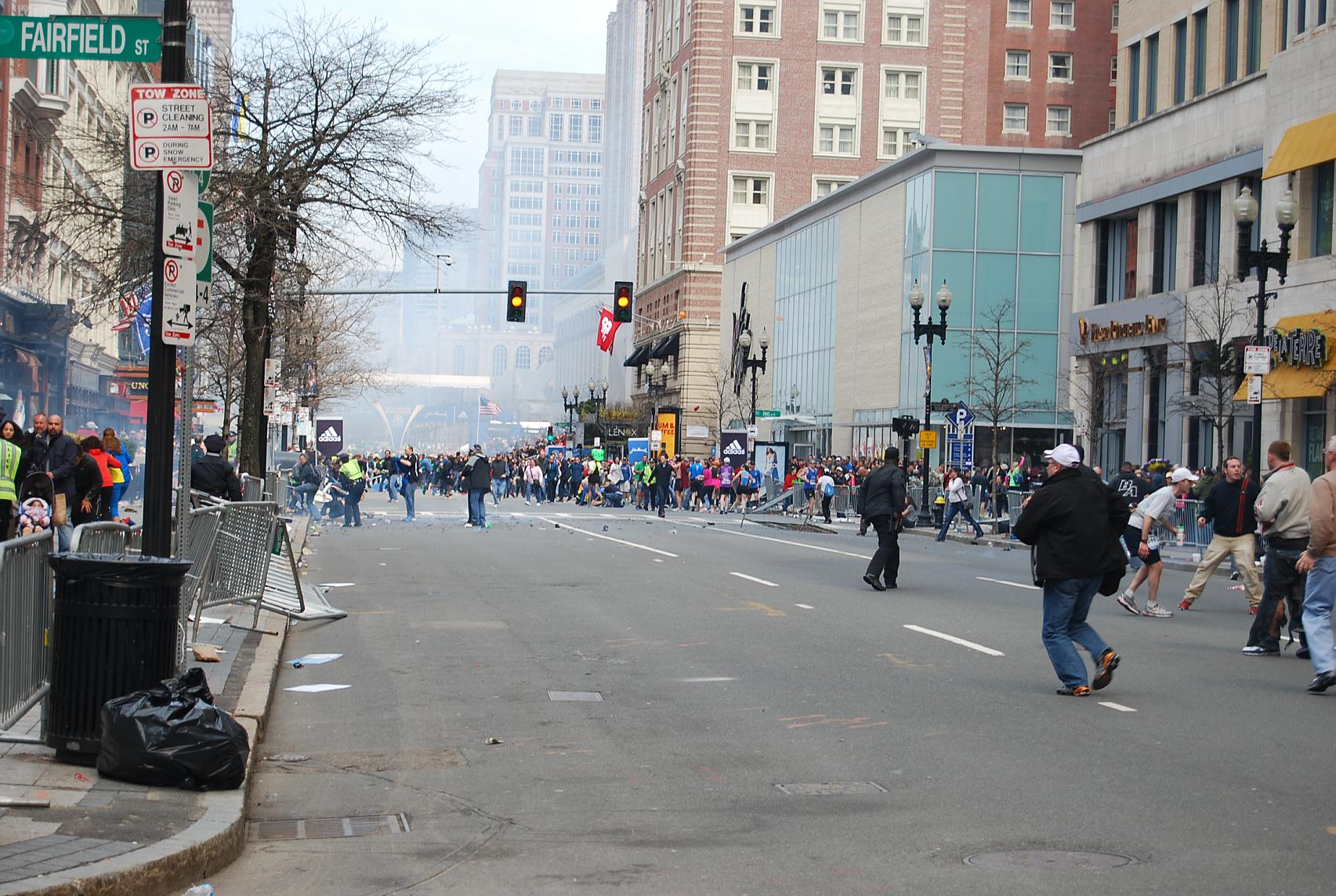
VICTIMS: I was standing about 20, 25 feet from the initial blast, so I
knew immediately what was going on.
MORGAN: Obviously you
knew that your wife Theresa was running. Your first thoughts I guess
must have been where on earth she was and was she safe.
PAINTER: It was. And I would like to commend the Boston Athletic
Association and the police, paramedics here, they did an outstanding
job. My wife was about two-tenths of a mile from the finish line and
they pushed her back from the second blast area so it was pretty
impressive, their response.
MORGAN: Theresa, you were
running in the marathon. You were near the finishing line. What was
your reaction when you heard the first explosion go off? THERESA
PAINTER, BOSTON MARATHON RUNNER: Well, I really wasn't paying attention
and then when I heard the bomb and saw the reaction of the spectators, I
was just alarmed. And then I was pushed back by a spectator, and Boston
Athletic officials grabbed a bunch of us and pushed us back. So it was
pretty upsetting.
MORGAN: And Dr. Painter, you actually
went to the Harris Regional Medical Center, I believe. Is that right?
Were you treating people there today?
DR. PAINTER: No. I
was treating people on the streets and assisted transferring them into
the medical tent. I work in Harris Regional Medical Center in
(INAUDIBLE) North Carolina.
MORGAN: So you were actually
treating people on the streets. What were you seeing? What was the type
of injury, how many people did you see injured there?
DR. PAINTER: I saw at least six to seven people down next to me. They
protected me from the blast. One lady expired, one lady -- one
gentleman lost both his limbs, lower extremities. Most of the injuries
were lower extremities. I could not figure out why the young lady had
expired, could not find any injury on her thorax. The other people I
saw were mainly lower extremity injuries.
MORGAN: Have you ever seen injuries like this in your time working in Boston?
DR. PAINTER: No. I have not had experience with blast injuries in
the past. I'm not military, so basically I'm used to more gunshot
wounds.
http://transcripts.cnn.com/TRANSCRIPTS/1304/15/pmt.01.html
O'REILLY: So first tell us about the woman who eventually died, Doctor - were you the first on scene there?
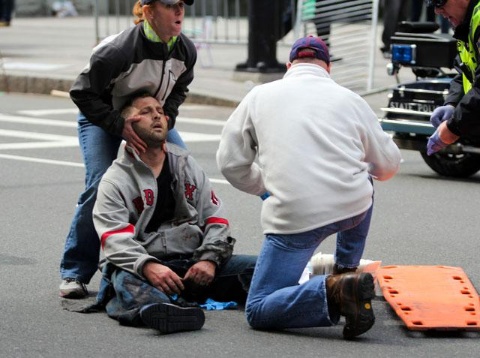
PANTER: I was one of the first, I don't know if I was the first one. Several people converged on the mass of bodies. We pulled a gentleman out from under her and then began working on her, too. She was basically in an arrest at the time. We thought we had a faint pulse. We started CPR (unintelligible) pulse or not. We started to kind of breathe her using an ambu bag. We ended up transporting her to the medical tent where she unfortunately expired.
O'REILLY: So she went into cardiac arrest, did she have other injuries from the bombing?
PANTER: She had injuries that we could visualize of her lower extremities, but could not find any obvious injury to her chest or abdomen, which was kind of puzzling. There was no evidence of shrapnel wounds to her chest that we could find on a cursory examining that we did. It was kind of puzzling. I don't know were these totally blast effects or what that caused the arrest.
http://video.foxnews.com/v/2306084131001/the-human-toll-of-terrorism/
Cardiopulmonary resuscitation (CPR) is an emergency
procedure for manually preserving brain function until further measures
to restore spontaneous blood circulation and breathing in a person who
is in cardiac arrest. It is indicated in those who are unresponsive with no breathing or abnormal breathing, for example, agonal respirations.
(Source: Wikipedia)
Sudden cardiac arrest (SCA) is a condition in which the heart
suddenly and unexpectedly stops beating. If this happens, blood stops
flowing to the brain and other vital organs. SCA usually causes death if it's not treated within minutes.
Overview
To understand SCA, it helps to understand how the heart works.
The heart has an electrical system that controls the rate and rhythm of
the heartbeat. Problems with the heart's electrical system can cause
irregular heartbeats called arrhythmias.
There
are many types of arrhythmias. During an arrhythmia, the heart can beat
too fast, too slow, or with an irregular rhythm. Some arrhythmias can
cause the heart to stop pumping blood to the body—these arrhythmias
cause SCA.
SCA is not the same as a heart attack.
A heart attack occurs if blood flow to part of the heart muscle is
blocked. During a heart attack, the heart usually doesn't suddenly stop
beating. SCA, however, may happen after or during recovery from a heart
attack.
People who have heart disease are at higher risk for SCA.
However, SCA can happen in people who appear healthy and have no known
heart disease or other risk factors for SCA.
(Source: http://www.nhlbi.nih.gov/health/health-topics/topics/scda/)